My church failed me — Jesus didn't
If members of a church can react like this you should be careful to attend. Be careful of spiritual abuse. They acted unbiblically to me and a member of 20 years who gave his heart to helping others.
A few members are nice, normal people. unfortunately there are ones that are doing very hurtful and evil things. The rest are ones that say nothing in the face of unbiblical conduct.
Very nasty mean people are at this building (I cannot call it a church of Christ any longer) flexing their power and hatefullness, including a woman that takes care of the office and funds. She acts more like a immature spoiled child at a Jr. high school age. This is what a poorly sheparded church looks like.
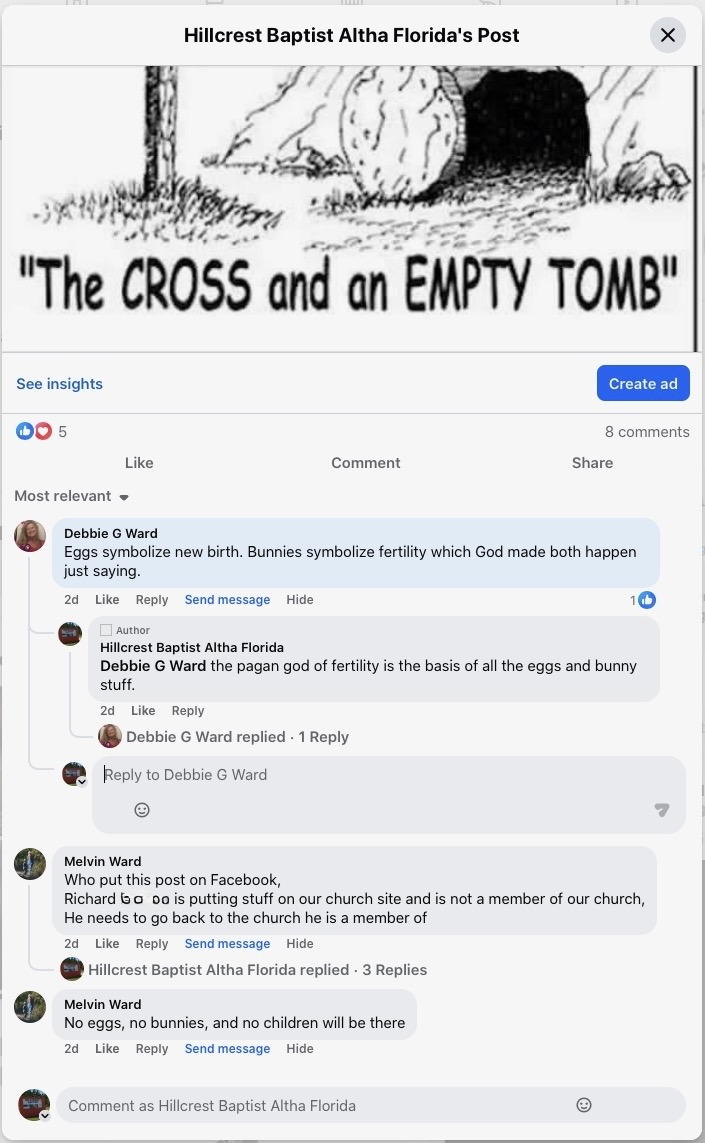
"Melvin XXXX
Who put this post on Facebook,
Richard XXXXXX is putting stuff on our church site and is not a member of our church, He needs to go back to the church he is a member of. "
I made a simple statement that eggs and bunnies are of pagan origin. Easter should focus on The Christ rising from the tomb. It should be The Savior alone, Christ alone. Part of the five solas, as the church should always do.. When a Church or so called christian places any act, person, place or thing above Jesus or a another believer who is upholding the Savior as their focus it is obvious who they are following and it isn't the Nazarine!
My church of 23 years failed me — Jesus didn't
By Teasi Cannon, Op-ed contributor
April 15, 2026

“You are a personal and professional offense to me!”
The words pierced my heart and echoed in my mind for weeks. My pastor — the man whose ministry had shaped my life for more than 23 years — believed I’d somehow damaged his reputation, and he was furious. Despite our best efforts to bring clarity and biblical resolve, a few months later, my husband and I were left with no choice but to leave the church we’d built, loved, and faithfully served. We were broken and utterly confused — and because of a toxic leadership structure with no accountability, we had no power to change it.
What we experienced has a name: spiritual abuse. It happens when those in positions of religious authority misuse God’s name, His Word, and their own influence to wound rather than shepherd — and the damage can leave eternal scars. Unlike the necessary offense of biblical truth — such as the reality of sin or the exclusivity of the cross — true spiritual abuse twists the truth for human power instead of pointing people to Jesus.
Research from the Barna Group confirms this is far from rare. More than a quarter of U.S. adults report past experiences with a religious institution as a key source of doubt in the Christian faith, and hypocrisy among believers is one of the most cited reasons people disengage. Many don’t leave in rebellion. They leave in self-preservation, concluding with genuine sorrow: “If this is Christianity, I can’t survive here.”
What makes spiritual abuse uniquely devastating is that it weaponizes the sacred. The place meant to bind up wounds becomes the source of them. The name of Jesus — the very name by which we’re made whole — is used to manipulate and control. For many survivors, it becomes nearly impossible to separate the abuser from the one he claimed to represent. Some can’t open a Bible or step into a church without real anxiety. I understand. It took some time for me to find the courage to return to a church community.
But what I’ve struggled to understand — not in judgment, but in real confusion — is how someone who has truly encountered Jesus can walk away from Him. The only way I’ve been able to make sense of it is this: we don’t fully appreciate being found until we understand how lost we are. We don’t grasp the good news until we’ve faced the bad news: our own guilt before a perfectly righteous God.
But I did.
Years earlier, I’d hit rock bottom in a way that left me alone in an apartment, sitting in the wreckage of my own choices, overwhelmed with shame and desperation. In that place, I became acutely aware of the weight of my own sin and my need for a holy God I had no right or ability to approach on my own. And Jesus met me there. He picked me up, loved me when I felt unlovable, and cleansed me when I felt buried in filth. When you know the Hell you’ve been rescued from, there’s no way you want to let go of your Savior.
My church hurt me. My Savior didn’t. And no one can take Him from me.
And yet we lost a great deal. Far more than a church. Because my husband was the children’s pastor, we lost his ministry, his income, and our health insurance. But those weren’t the deepest losses. We lost people — mentors, close friends, and ministry partners — the people I thought would fill the pews at my funeral. It felt as though my past, present, and future had been taken at the hands of one powerful and offended man.
While my little family worked to stop the bleeding and clear enough of the rubble to move forward, it seemed as if no one skipped a beat back in our former church. The pastor continued preaching to much applause and affirmation. That felt so very wrong.
But God isn’t silent about this.
In Ezekiel 34, He speaks with unmistakable fury against shepherds who exploit and scatter the flock rather than protect it. And in Matthew 18:6, Jesus warns that anyone who causes vulnerable believers to stumble would be better off with a millstone around his neck than face His judgment. A God who speaks this clearly against those who harm His people is a God worth trusting — not walking away from.
If you’re reading this from the rubble of a church that wounded you, hear this: what was done to you was wrong. God sees it. Your pain matters, and you are neither alone nor forgotten.
You may still find yourself crying out like the prophet Jeremiah, “Why do the wicked prosper … why do the treacherous thrive?” (Jer. 12:1). Scripture doesn’t ignore that question. It answers it with something higher. Jesus promised this life would include tribulation (John 16:33). He Himself was betrayed, rejected, and crucified, and yet He overcame the world. He endured the cross for the joy set before Him (Heb 12:2). He isn’t asking us to walk a road He hasn’t walked Himself.
He has promised that one day every tear will be wiped away and every wrong made right (Phil. 2:10; Rev. 21:4). And most beautifully, through the apostle John, He has promised us: “Behold, I am making all things new … these words are trustworthy and true” (Rev. 21:5).
Jesus continues to heal my broken heart, and in His merciful kindness has allowed me to share that comfort with others. I’m fully convinced we have a transcendent hope in the one whose life, death, and resurrection have proven His faithfulness. This isn’t the end of our story, and one day Jesus will look into every heart and — echoing the words of Ezekiel 34 — ask, “How did you treat my lambs?”
We can trust a Savior like that. If you’re still holding on with all you’ve got, don’t let go.
He is the Good Shepherd — the One who heals what no one else can. And He never fails.
Teasi Cannon is an author, speaker, and host of the True Comfort Podcast. She is a lifelong learner who is passionate about helping others cultivate a sound and enduring devotion to Jesus.
Teasi holds a B.S. in Interdisciplinary Studies from Middle Tennessee State University School of Education and Behavioral Science, an M.A. in Pastoral Counseling from Liberty Theological Seminary, and a certificate in Christian Apologetics from Southern Evangelical Seminary. She is a board member with BeEmboldened, a non-profit that provides support in the prevention of and healing from harmful religious experiences.
Teasi lives south of Nashville, Tennessee with her husband and best friend Bill. They have three amazing children who all grew up far too quickly, a wonderful son- and daughter-in-love, and the most precious grandchildren the world has ever seen. For more about Teasi, check out her website at www.teasicannon.com.
Matthew 10:13-15
13 And if the house be worthy, let your peace come upon it: but if it be not worthy, let your peace return to you.
14 And whosoever shall not receive you, nor hear your words, when ye depart out of that house (church) or city, shake off the dust of your feet.
15 Verily I say unto you, It shall be more tolerable for the land of Sodom and Gomorrha in the day of judgment, than for that (church) city.
This is a church that has no conscience or value for others. The key members only value their own pride and power. Be very careful if you choose to enter upon the churches grounds.
Matthew 10:13-15
The Word of Promise® NKJV Audio Bible
14 “And whoever will not receive you nor hear your words, when you depart from that house, church or city, shake off the dust from your feet.
15 “Assuredly, I say to you, it will be more tolerable for the land of Sodom and Gomorrah in the day of judgment than for that city (or church)!
Matthew 10:14-15 NKJV-Mac
Commentary Mat 10:14 The priority was to preach that the King had come and His kingdom was near. The message was the main thing. The signs and wonders were to authenticate it. It was common for Jews to shake the dust off their feet—as an expression of disdain—when returning from Gentile regions. Paul and Barnabas also did this when expelled from Antioch (Acts 13:51). This was a visible protest, signifying that they regarded the place as no better than a pagan land.
Mat 10:15 Those cities and the entire surrounding region were judged without warning, and with the utmost severity
The Word of Promise® NKJV Audio Bible
16 “Behold, I send you out as sheep in the midst of wolves. Therefore be wise as serpents and harmless as doves.
17 “But beware of men, for they will deliver you up to councils and scourge you in their synagogues.
18 “You will be brought before governors and kings for My sake, as a testimony to them and to the Gentiles.
19 “But when they deliver you up, do not worry about how or what you should speak. For it will be given to you in that hour what you should speak;
Matthew 10:16-19 NKJV-Mac
Key arguments that church membership is not biblical:
* No Explicit Command: The New Testament does not contain a direct command to join a local church through membership, nor did early apostles hold membership classes.
* Creates Division: It creates a two-tier system of "insiders" and "outsiders," which can foster elitism, resentment, and an artificial division in the body of Christ.
* Modern Institutionalism: Formal, listed membership is seen as a modern, legalistic innovation (consumerism) rather than the organic, fellowship-based community of the early church.
* Potential for Abuse: It can lead to pastors abusing power (controlling or bullying members) and creates a culture of fear surrounding church discipline.
* Misplaced Security: Some argue that it encourages people to trust in their membership status rather than in their personal salvation and relationship with God.
Church cliques are small, exclusive groups within congregations that, unlike healthy friend groups, are often unwelcoming to newcomers or outsiders. They frequently form based on shared interests, life stages, or long-term friendships, creating insular environments that can lead to division, gossip, and the departure of new members.
Characteristics of Church Cliques
* Exclusivity: A "closed-door" mentality where groups are uninterested in broadening their circle, say GotQuestions.org.
* Unwritten Rules: They often have established, unspoken ways of running ministries or social events.
* Self-Centeredness: These groups may prioritize their own needs and comforts over welcoming or caring for others.
* Lack of Inclusivity: They can be particularly intimidating to visitors, hindering the church's mission to be welcoming.
Causes and Impact
* Natural Tendency: People tend to gather with those similar to them, but this becomes a "clique" when it breeds insularity.
* Negative Impact: Cliques can cause emotional damage, create "us vs. them" mentalities, and divide the church.
* Spiritual Danger: Some on Reddit r/Exvangelicalexpressed that cliques can falsely equate popularity within the group with spiritual maturity, causing immense harm to those outside it.
Overcoming Cliques
* Leadership Initiative: Leaders should encourage a welcoming atmosphere and intentionally mix groups, according to ChuckLawless.com.
* Individual Action: Being aware of the tendency toward favoritism and making a conscious effort to break it, suggests GotQuestions.org.
* Fostering Inclusivity: Creating intergenerational and diverse small groups can break down barriers, say Chuck Lawless
It is important to differentiate between healthy, open friendships and exclusionary cliques, some are toxic to others desiring community and belonging says ChuckLawless.com.

ChuckLawless.com
clique
/klēk/
A clique is a small, exclusive group of people who interact frequently, sharing similar interests while often excluding others. Originating from the 14th-century French term for a "sharp noise" or "latch" (referring to a tight-knit group), cliques feature high loyalty, leaders, and strict social rules. They provide belonging and social status but can be exclusionary and manipulative.
Characteristics of a Clique
Exclusivity: Tight-knit members who rarely welcome outsiders.
Hierarchical Structure: Typically led by one or two individuals who define group rules.
Shared Traits: Members often share similar social characteristics, interests, or statuses.
Interpersonal Dynamics: Often associated with "mean girl" behavior in schools, but common in workplaces too.
How a Clique Functions
Cliques function by creating a strict insider/outsider boundary. They offer a sense of security and popularity to members but often operate by exerting peer pressure, controlling behavior, and enforcing loyalty through gossip or intimidation. They are considered a normal part of social development, allowing individuals to navigate social hierarchies
Check out this video, "piper on ai prayer"
he says ai has words bu no soul, neither do cliques
https://youtu.be/CIMZH7DEPPQ?si=YnhBUbldeDco7xmR
https://youtu.be/d3vVho-U13I?si=uF7HdiKb1UKaSqMa
https://youtu.be/h7T_UL46s1E?si=-QBBBvsPGW2HRLom
https://www.facebook.com/share/v/14cYfuHXQiL/?mibextid=wwXIfr
https://youtu.be/7ysMjlzZxPs?si=YxJM8J6_SDDoLVQ8
Key reasons for this behavior include:
* The "Holy Huddle" Syndrome: Members often gravitate toward familiar friends and social circles, which can make newcomers or non-members feel invisible or unwelcome.
* Insularity and Inward Focus: Many churches prioritize the needs and comforts of existing members over outreach to the community, resulting in a cliquish environment.
* "Stand-and-Greet" Limitations: A brief, mandated greeting time during a service is often mistaken by members for true hospitality, while guests perceive it as forced or superficial.
* Legalism and Self-Righteousness: A, "formulaic" approach to faith can lead to judgmental attitudes, where members feel superior to those outside their clique.
* Individual Burdens and Hypocrisy: Churchgoers are not immune to life's stresses, which can cause them to be irritable or short-tempered. Others may act inconsistently with their faith.
* Cultural Differences and Fear: Insecurity, introversion, or simply not knowing how to act comfortably with strangers can be perceived as coldness.
Founder
“My church is a mean church!”
I received two emails this week from church members who made that very statement. The members are from two different churches in two different states. One of the churches belongs to a denomination; the other is non-denominational. In both cases the church members made the decision to drop out of local church life altogether.
Yes, I tried to reason with the two members. I told them that no church is perfect. If they had any doubt, I wrote, look at the two letters the Apostle Paul wrote to the church at Corinth. I failed in convincing them to stay in their churches. I pray they will become active in other churches later.
I love local churches. But I have to admit, I am hearing more from long-term members who are quitting church life completely. One member wrote me, “The non-Christians I associate with are much nicer people than the members of my church.”
Ouch. That really hurt.
So, after receiving the second email, I began to assimilate all the information I could find where church members had written me about their “mean” churches. They may not have used the word “mean” specifically, but the intent was the same. I then collected characteristics of these churches, and I found nine that were common. I call these the “nine traits of mean churches.”
1. Too many decisions are made in the cloak of darkness. Only a select few members really know what’s going on. The attitude of those elitists is that the typical member doesn’t really need to know.
2. The pastor and/or staff are treated poorly. Decisions are made about them without a fair process. Complaints are often numerous and veiled. Many of these churches are known for firing pastors and/or staff with little apparent cause.
3. Power groups tenaciously hold on to their power. The power group may be a formal group such as a committee, elders, or deacons. But the group can also be informal—no official role but great informal authority. Power groups avoid and detest accountability, which leads to the next point.
4. There is lack of clear accountability for major decisions and/or expenditures. The church has no clear system in place to make certain that a few outlier members cannot accumulate great power and authority.
5. Leaders of the power groups have an acrimonious spirit. Though they may make first impressions of kindness and gentleness, the mean streak emerges if you try to cross them.
6. A number of the members see those outside of the church as “them” or “those people.” Thus the church is at odds with many in the community instead of embracing them with the love of Christ.
7. Many members have an inward focus; they view the church as a place to get their own preferences and wants fulfilled. They are the opposite of the description of church members in 1 Corinthians 12, where Paul describes them as functioning members for the greater good of the body of Christ.
8. Many people in the community view these churches negatively. Those on the outside often refer to these churches as “fighting and firing churches.” The community members detect no love for them from these churches.
9. Most of the members are silent when power plays and bad decisions take place. They don’t want to stand up to the power group. They are afraid to ask questions. Their silence allows the power abuses to continue.
Are mean churches really increasing in number? My anecdotal information would indicate they are.